Tuesday, October 26, 2010
Wednesday, October 13, 2010
[paradigm map research].
Below is the current trajectory for the Paradigm Map. Research is organized into branches and sub-branches, and will be combined with other student research to generate a graphic based off of transit/subway maps.
MEMORY (main branch)
GENERAL MEMORY
Memory and architecture/Bastea
Memory and architecture/Bourgeois
Made to stick: why some ideas survive and others die/Heath and Heath
Architectural psychology: proceedings of the Lund Conference/Kuller
METHODOLOGIES
Psychology of architectural design/Akin
The art of memory/Yates
MONUMENT/OBJECT
The destruction of memory: architecture at war/Bevan
Body, memory, and architecture/Bloomer and Moore
The art of memory/Yates
A tour of the monuments of Passaic, New Jersey/Smithson
PROJECTS
Zollverein Kohlenwasche/Koolhaas (monument)
Gas Works Park/Haag (monument)
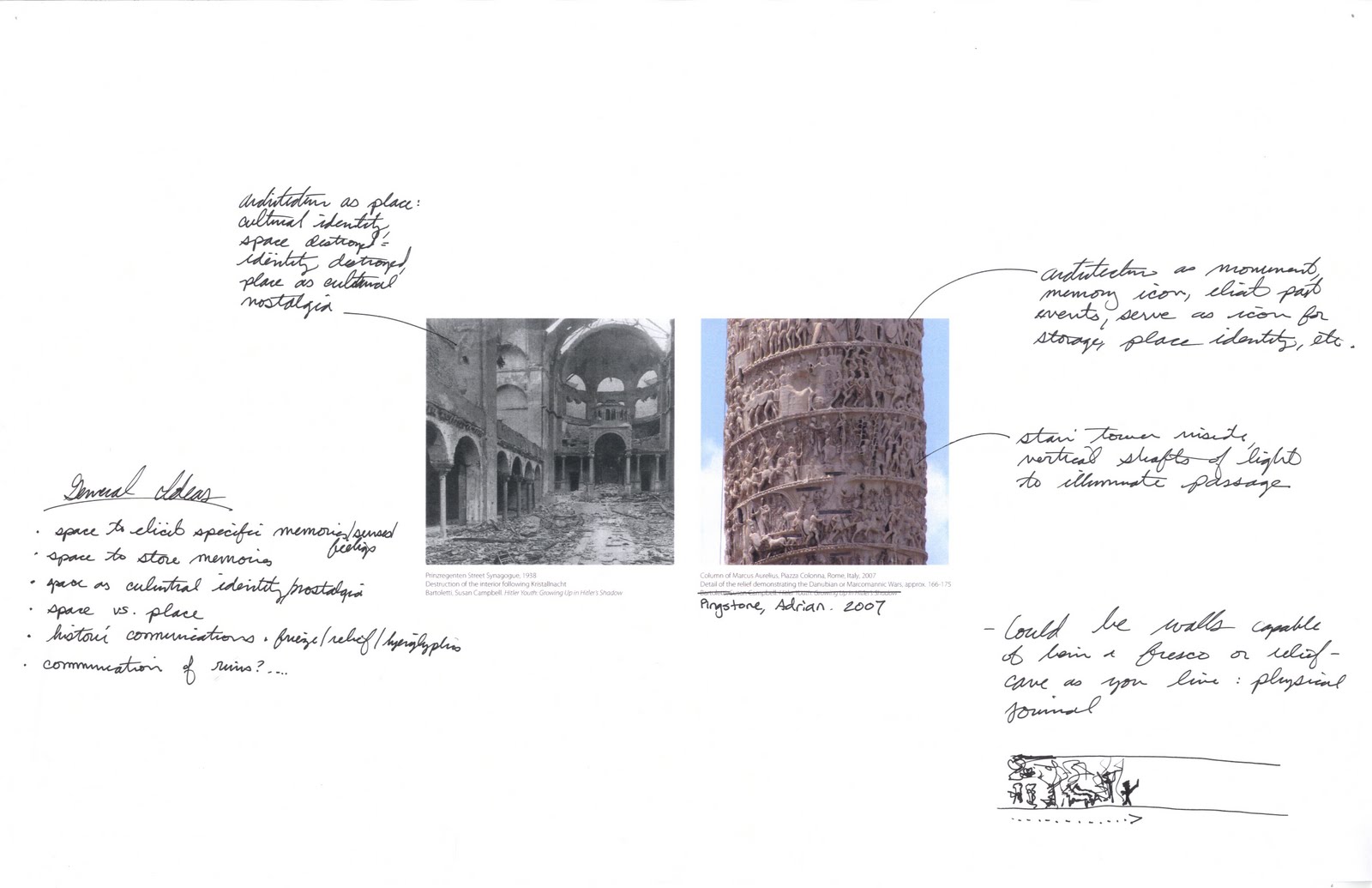
Column of Marcus Aurelius/Roman ruins (methodologies and monument)
Igualada Cemetery/Miralles and Pinos (monument)
PLACE EXPERIENCE (main branch)
SPACE/PLACE
Caring for places: what does it take to make a place?/Lyndon
Genius loci/Norberg-Schulz
Mythologies of placemaking/Wortham-Galvin
HOME
Place advantage: applied psychology for interior architecture/Augustin
Some place like home: using design psychology to create ideal places/Israel
A world of their own making/Gillis
The not so big house: a blueprint for the way we live/Susanka
Patterns of home: the ten essentials of enduring design/Jacobson
House as mirror of self/Cooper-Marcus
Symbolic meanings of house styles/Nasar
Corporeal experience: a haptic way of knowing/O’Neill
COMMUNITY
Civic meaning: the role of place, typology, and design values in urbanism/Groat
Creating community: does the Kentlands live up to its goals?/Kim
The edge and the center: gated communities and the discourse of urban fear/Low
SENSES (main branch)
Place advantage: applied psychology for interior architecture/Augustin
Thursday, October 7, 2010
[site as thesis].
The site as thesis focused on how memory influences experience and likewise how experience influences and creates memory. The different scales at which this interchange operates becomes the site.
First, on the larger scale, memory is influenced by a collective experience. Culturally and socially shared pre-dispositions, prejudices, and preferences combine to color the perception of events, places, and people, and thereby color memories of those moments. The notions passed from person to person within the social network form a memory map through society, with each individual as a node of transmission.
Next, on an individual scale, memory is shaped through each unique experience. As recollection occurs, the mind sorts through the cloud of memories in storage. The first layer of recollection achieved is association. When an experience/place/person is recalled, associations are first made- was it a joyous or negative experience? Next, more specific details about the experience come to life- how did the situation play out, what actors were present, what nuances change the course of events? Finally, the deepest level of the memory is where negative feelings reside (perhaps as a level of protection for the body). Certain memories reside too deeply to even be recovered clearly.
Junk Drawer: the junk drawer represented a physical site for memory, contained in two parts. One, the objects contained, and two, the mental associations with those objects. The relationship between object and memory, the physical with the mental, is what I'm hoping (at this point anyway) to pursue architecturally.
Tuesday, September 28, 2010
[place].
I've been reading articles on place and experience, and am attaching to certain arguments presented by J. Gillis and B. D. Wortham-Galvin (among others, including Norberg-Schulz). When framing the thesis as site exercise, I'm trying to consider the mind, and how space exists in both the physical and emotive sense. Gillis discusses how the people we surround ourselves with and model our lives by (families specifically) are really separate entities. One is physical, the other is a construct. Similarly, Wortham-Galvin describes this theme in terms of place- that place is both physical space and the mental associations that come with. Further, Norberg-Schulz discusses that place is composed of both "structure" and "character", again referring to the doubled sided construct of space. I feel the site for my thesis then is both one that is real and one that is imagined/constructed/experienced. The site seems to unquestionably need dual dimensions.
*J. Gillis, "A World of Their Own Making"
*B. D. Wortham-Galvin, "Mythologies of Placemaking"
*Norberg-Schulz, "Genius Loci"
*J. Gillis, "A World of Their Own Making"
*B. D. Wortham-Galvin, "Mythologies of Placemaking"
*Norberg-Schulz, "Genius Loci"
Wednesday, September 22, 2010
Subscribe to:
Posts (Atom)